


Lab Grown Diamonds vs. Mined Diamonds: How They Compare and Which to Choose
Key Takeaways
- Same diamond, different origin. Lab grown and mined diamonds share the same carbon crystal, a Mohs hardness of 10 and a refractive index of 2.42.
- The price gap is wide. A lab grown center stone can cost roughly 80 to 90% less than a comparable mined one. On small accent diamonds, the gap is closer to 35 to 45%.
- Neither is an investment. Mined diamonds keep partial resale value. Lab grown diamonds keep very little.
- Grading changed in 2025. GIA now rates colorless lab grown stones as Premium or Standard, while IGI still issues full 4Cs reports.
- Your eye can't tell them apart. Only lab equipment and the grading report confirm origin.
- Choose by priorities. Lab grown wins on size per dollar. Mined wins on rarity, tradition and long-term value.
Lab grown diamonds vs mined diamonds: which one belongs in your ring?
Here's the short answer. Both are real diamonds. They share the same carbon crystal, the same hardness and the same sparkle. What differs is origin, price, resale value and the grading report you get. A lab grown center stone often costs roughly 80 to 90% less than a comparable mined one.
That's the headline. The details decide which is right for you.
At CALVIN'S, we sell both natural and lab grown diamonds and show them side by side in our Austin showroom. Here is what we walk couples through every week.
Lab Grown Diamonds vs Mined Diamonds at a Glance
Lab grown diamonds vs mined diamonds match on every physical row below and split on every money row. The hardness and refractive index figures come straight from the FTC Jewelry Guides definition of a diamond.
| Factor | Lab Grown Diamond | Mined Diamond |
|---|---|---|
| Material | Pure crystallized carbon | Pure crystallized carbon |
| Hardness (Mohs scale) | 10 | 10 |
| Refractive index and sparkle | 2.42, same brilliance and fire | 2.42, same brilliance and fire |
| Look to the naked eye | Identical | Identical |
| How and how long it forms | HPHT or CVD in a lab, in weeks | Deep in the earth, over 1 to 3 billion years |
| Typical 2026 price | Roughly 80 to 90% less for a comparable center stone; about 35 to 45% less on small accent diamonds | Full natural market price |
| Resale value | Little to none | Partial |
| Grading report | GIA Premium or Standard, or IGI full 4Cs | GIA or IGI full 4Cs |
| Girdle inscription | "Laboratory-Grown" or lab grown mark, plus report number | Report number, when inscribed |
| Supply and rarity | Made to order, not rare | Finite and geologically rare |
| Sourcing assurance | Documented lab origin | Kimberley Process for rough diamonds |
The bottom line? Judged on looks alone, you'd never pick a side. The choice comes down to budget, value over time and what the stone's origin means to you.
Are Lab Grown Diamonds Real Diamonds?
Yes. In 2018, the FTC dropped the word natural from its definition of a diamond. Today a diamond is simply pure carbon crystallized in the isometric system, with a hardness of 10 and a refractive index of 2.42.
There is one rule attached. Under the FTC Jewelry Guides, sellers must label these stones "laboratory-grown," "laboratory-created" or "[manufacturer]-created," and can't describe them as natural. That's why you'll hear us say "real diamonds, grown in a lab" rather than "real" on its own.
Naming trips people up, too. Lab grown, lab created, laboratory-grown and man-made all describe the same product. So if you searched "lab created diamonds vs mined," you're reading the right comparison.
What a lab grown diamond is not is a simulant:
| Stone | What it's made of | Mohs hardness | Is it a diamond? |
|---|---|---|---|
| Lab grown diamond | Carbon | 10 | Yes |
| Moissanite | Silicon carbide | About 9.25 | No, a simulant |
| Cubic zirconia | Zirconium dioxide | About 8 to 8.5 | No, a simulant |
Simulants only look like diamonds. Our lab grown diamonds at CALVIN'S are real diamonds, grown in a lab, and every ring with a diamond choice is clearly labeled natural or lab grown before you buy.
How Mined and Lab Grown Diamonds Are Formed
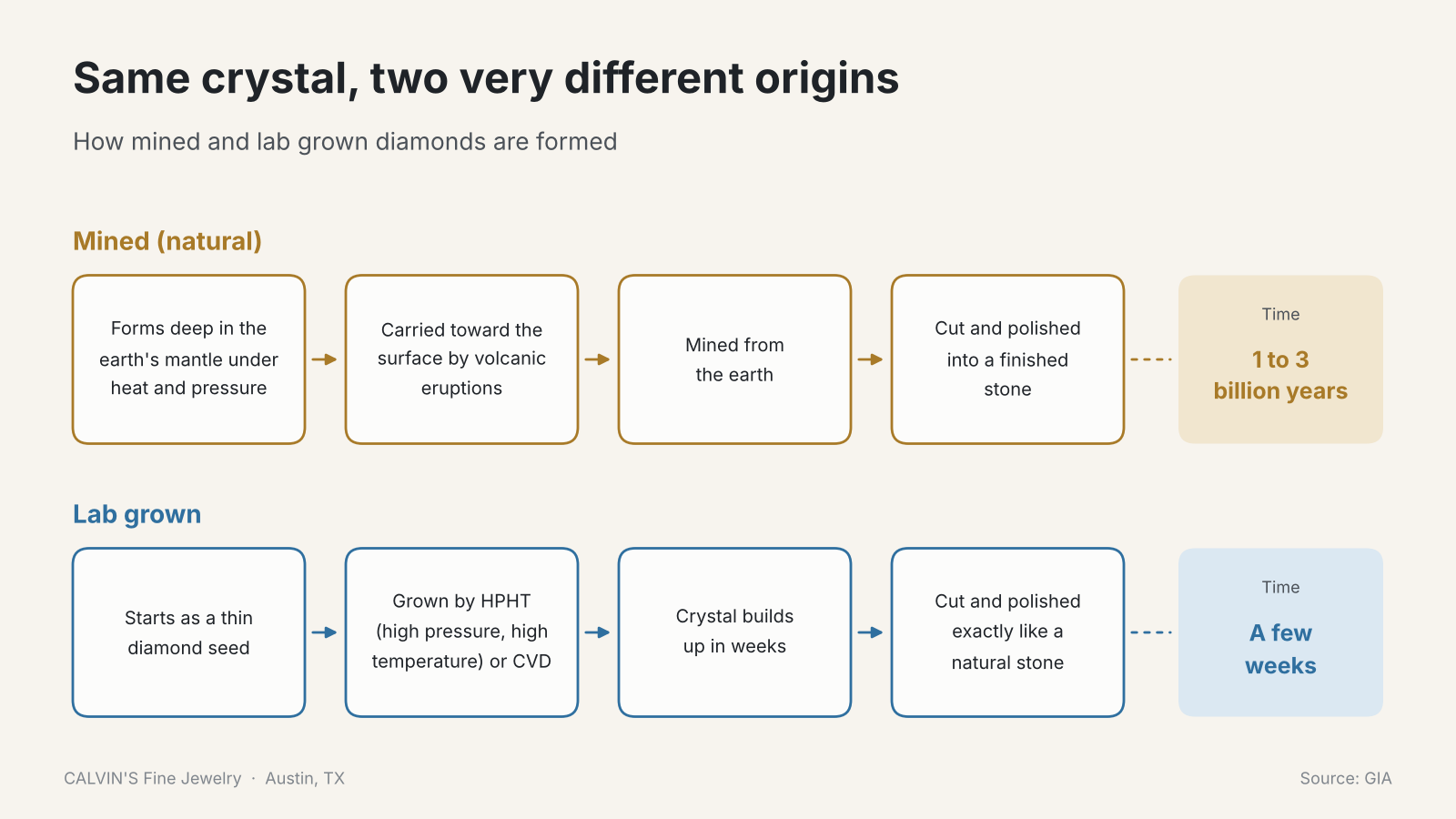
Every other difference in this guide starts with origin. One stone took billions of years. The other took a few weeks.
Mined (Natural) Diamonds: Billions of Years in the Making
Natural diamonds formed deep in the earth's mantle about 1 to 3 billion years ago, under intense heat and pressure. Volcanic eruptions later carried them toward the surface, where they are mined today.
Each rough stone is then cut and polished by hand and machine. Supply is finite, which is why every earth-mined diamond is geologically rare.
Lab Grown Diamonds: Weeks, Not Eons
A lab grown diamond starts as a thin diamond seed. Growers then use one of two methods:
- HPHT (high pressure, high temperature): a press recreates mantle-like conditions around the seed.
- CVD (chemical vapor deposition): carbon from a gas settles on the seed, building the crystal layer by layer.
Growth takes weeks. The rough crystal is then cut and polished exactly like a natural stone. GIA explains how laboratory-grown diamonds are made and identified if you want the science in full.
Can You Tell the Difference Between Lab Grown and Mined Diamonds?
Not by eye, and not with a jeweler's loupe. Set side by side under the same light, a well-cut lab grown stone and a well-cut mined stone look the same.
Here's what surprises most shoppers: standard handheld diamond testers read both as diamond. Those tools are built to catch simulants like cubic zirconia, not to reveal where a diamond came from.
So how is origin confirmed? Gem labs rely on three things:
- Screening and spectroscopy, using instruments such as GIA's iD100, which flag stones that need further testing.
- Growth patterns visible under advanced lab imaging, since HPHT and CVD crystals grow in shapes that natural diamonds don't.
- A laser inscription on the girdle of every graded lab grown stone, noting its lab grown origin and report number.
Our advice is simple. Always get the grading report, and ask your jeweler to show you the inscription under magnification so you can match it. GIA's guidance on identifying lab-grown diamonds covers the science.
Inclusions won't settle it either. Both types can carry them, as we explain in our guide to diamond inclusions.
Lab Grown vs Mined Diamonds Price: The 2026 Gap
This is where the two part ways. Lab grown diamonds can sell for up to 90% less than an equivalent natural diamond, according to diamond analyst Paul Zimnisky. The gap also grows as carat size rises.
Why so much cheaper? Production scaled fast, and prices fell with it. In 2025, De Beers closed its Lightbox lab grown brand, pointing to falling lab grown prices. Natural prices have slipped too, as the resale section shows.
Real Prices, Side by Side
The size of the gap depends on what you compare. Small accent diamonds show a modest difference, while a center stone shows the dramatic one:
| Example | Diamond weight | Lab grown vs natural |
|---|---|---|
| NESTA Ring, our half eternity band | 3/8 ct total | About 45% less |
| ELAIN Ring, our graduated band | 0.33 ct total | About 35% less |
| Nearly colorless, VS, excellent-cut stone (InvestmentNews, Sept 2026) | Single stone | About $450 vs $2,800 to $3,200, roughly 85% less |
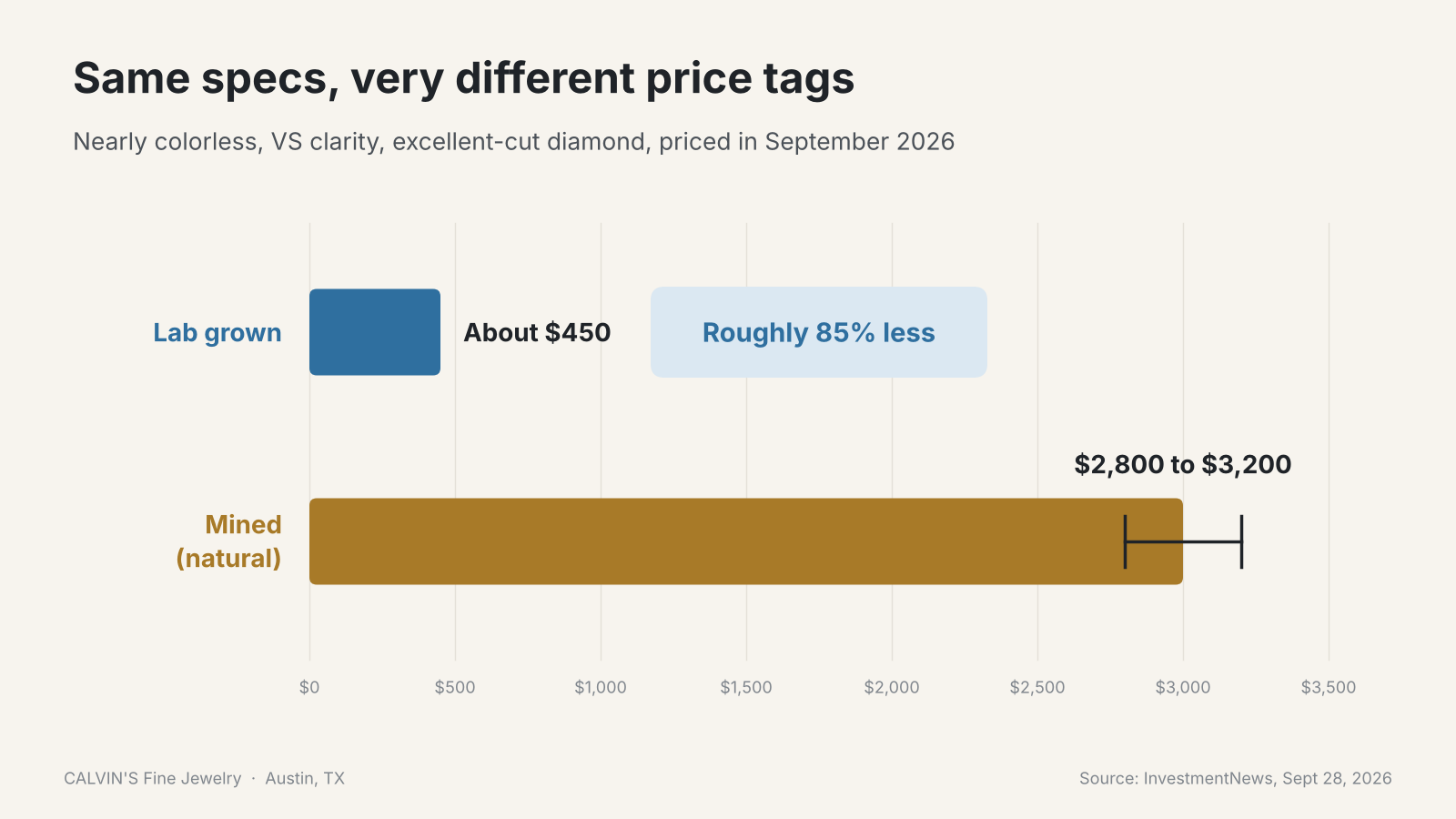
That's why the center stone is where most couples feel the difference. Both of our bands above come in either diamond type, so you can compare them in person.
What the Same Budget Buys You
The gap matters most when you hold your budget steady. With a lab grown center stone, the same spend can get you:
- A larger stone, such as moving from a 1 ct look to a 2 ct or larger look.
- A higher color or clarity grade at the same size.
- A finer setting, like platinum or a hidden halo.
- Room for wedding bands inside the same total.
One rule holds for both types: spend on cut quality first. Cut drives sparkle more than any other C, so a well-cut smaller stone will outshine a poorly cut bigger one.
You can browse current lab grown diamond jewelry online. If you'd like to spread the cost, see our payment options and financing.
Resale Value: Does Either Diamond Hold Its Worth?
Let's be direct: neither is an investment. The retail price includes cutting, setting, labor and the jeweler's margin, and none of that comes back if you sell.
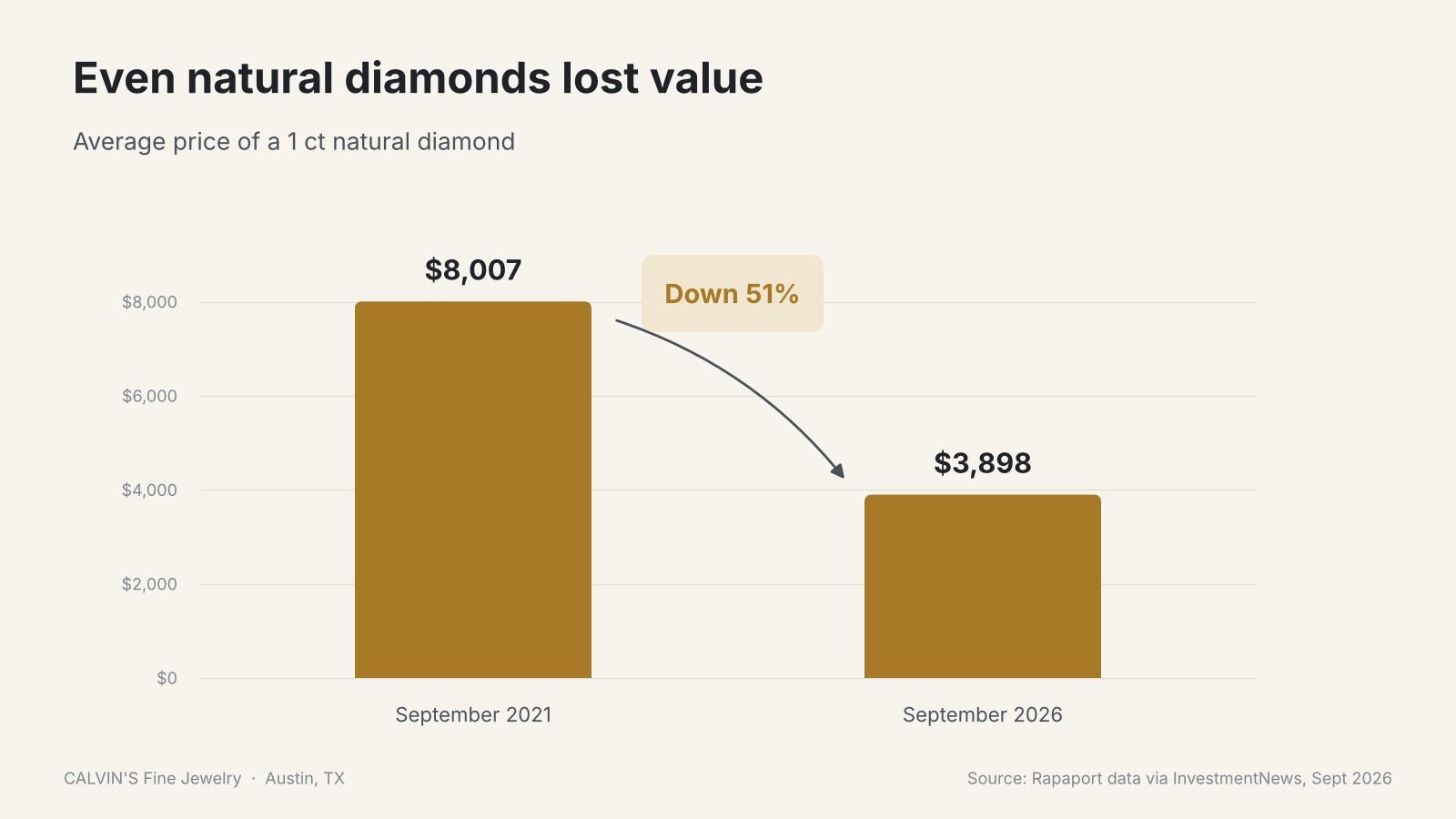
Mined diamonds keep partial resale value, but even that has slipped. The average 1 ct natural diamond fell from $8,007 in September 2021 to about $3,898 in September 2026, a drop of roughly 51% (Rapaport data via InvestmentNews).
| Resale factor | Lab Grown Diamond | Mined Diamond |
|---|---|---|
| Secondary market | Very small | Established |
| What you'd get back | Little to none | A fraction of retail |
| Price trend | Still easing | 1 ct average down about 51% since 2021 |
With lab grown diamonds vs mined, resale is the clearest split. Few buyers pay much for a used lab grown stone, because new ones keep getting cheaper.
Appraisal and Insurance Work the Same
The good news? Both types can be appraised and insured at replacement value, which protects you against loss, theft or damage.
Alexandra de Marigny, an independent GIA Graduate Gemologist and member of the International Society of Appraisers, works out of our showroom. She offers independent in-store appraisals for insurance and estate purposes, on CALVIN'S pieces and estate jewelry alike. Keep the appraisal with your grading report, and update it every few years.
Grading Reports: How GIA and IGI Grade Each Type
Natural diamonds still get full 4Cs grades (cut, color, clarity and carat) from both GIA and IGI. Lab grown stones are now handled differently, depending on which lab grades them.
Since October 1, 2025, GIA no longer gives colorless lab grown diamonds letter grades. Each stone instead receives a Quality Assessment of Premium or Standard, and a stone that misses the Standard bar gets no assessment at all. See GIA's laboratory-grown diamond services for the full rules.
| GIA classification | Color | Clarity | Cut (round brilliant) | Polish and symmetry |
|---|---|---|---|---|
| Premium | D only | VVS or better | Excellent | Excellent |
| Standard | E to J | VS or better | Very Good or better | Very Good or better |
IGI takes the other path. IGI still issues full 4Cs reports for lab grown diamonds, so you'll see familiar grades like G color and VS1 clarity. Older GIA lab grown reports with letter grades remain valid.
How to Check Any Diamond Report
A report only protects you if it matches the stone in front of you. Before you buy either type, check three things:
- The origin line states natural or laboratory-grown.
- The girdle inscription matches the report number.
- The report number verifies on the grading lab's website.
New to the grading terms? Our diamond education guide to the 4Cs explains each one in plain English.
Ethics and Environmental Impact
Both choices carry trade-offs. We'd rather show you them than sell you a slogan.
Mined diamonds: the Kimberley Process certifies the rough diamond trade across 86 countries, about 99.8% of global production, to keep conflict diamonds out of the supply. Mining supports jobs in producing economies, but it also disturbs land.
Lab grown diamonds: no mining is required, and the origin is documented. Growing them is energy-intensive, though, so the real impact depends on the power source behind the lab.
A few questions worth asking any jeweler, including us:
- Can you show sourcing or Kimberley Process paperwork for this mined stone?
- Where was this lab grown diamond made, and on what kind of power?
- Does the grading report confirm the origin?
Be wary of blanket green claims. The FTC warned sellers in 2019 against calling diamonds "eco-friendly" or "sustainable" without the evidence to back it up.
Mined vs Lab Grown Diamonds: Which Should You Choose?
You're in good company either way. 61% of engagement rings for couples married in 2025 had lab grown center stones, according to The Knot, up 239% since 2020.
But popularity isn't a reason on its own. With mined vs lab grown diamonds, the right pick depends on what you value most.
| Lab Grown Diamond | Mined Diamond | |
|---|---|---|
| Pros | Roughly 80 to 90% less for a comparable center stone; more size or quality per dollar; no mining required; same hardness and sparkle | Rare and finite; keeps partial resale value; billion-year origin; full 4Cs grades from GIA and IGI |
| Cons | Little to no resale value; prices still falling; no letter grades on new GIA reports; energy-intensive to grow | Costs far more for the same look; resale is only a fraction of retail; mining disturbs land |
Choose a Lab Grown Diamond If...
Lab grown makes sense when budget and size lead the conversation:
- You want the most size and quality for your money.
- You love the look of a 2 ct or larger center stone.
- You'd rather put the savings toward the setting, the honeymoon or a home.
- Resale value doesn't matter to you.
It's an especially strong fit for a bold solitaire engagement ring, where the center stone does all the talking.
Choose a Mined Diamond If...
Mined makes sense when meaning and longevity lead:
- Rarity and a billion-year origin matter to you.
- You want an heirloom that keeps partial resale value.
- Tradition is part of what the ring means to your family.
For some couples, the story of the stone matters as much as its size. That's a perfectly good reason.
Our Verdict
Neither is the "better" diamond. Lab grown is the better value for size, and mined is the better choice for rarity and partial resale.
Whichever you choose, cut drives diamond brilliance. Elongated shapes need care with the oval bow-tie effect, and how to choose a diamond ring setting works the same way for both.
Ready to picture it on your hand? Start with our engagement rings, which can be set with either stone.
See Lab Grown and Mined Diamonds Side by Side in Austin
Reading only gets you so far. The fastest way to settle lab grown diamonds vs mined diamonds is to see them together, under the same light.
CALVIN'S has been Austin's family jeweler since 1997, with three generations at the bench and a GIA-certified staff. Many of our rings come with a choice of natural or lab grown diamonds, so you can compare both in the same design and see the price difference for yourself.
Every piece you buy from us is covered by the CALVIN'S Promise:
- Complimentary cleaning, polishing and inspection for as long as you own it
- A 1-year warranty, with repairs at no charge in the first year under normal wear
- Free prong checks and tightening, which we suggest every 3 to 6 months
- Honest advice on both diamond types, with no pressure toward either
Ready to compare? Book a side-by-side diamond viewing and we'll set both in front of you. You can also design a custom engagement ring or browse diamond rings (natural and lab grown) before you visit.
Lab Grown vs Mined Diamonds FAQ
Quick answers to the questions couples ask us most in the showroom.
Are lab created diamonds the same as lab grown diamonds?
Yes. They are two names for one product, so "lab created diamonds vs mined" is the same comparison as this guide.
Neither term covers moissanite or cubic zirconia. Those are simulants made of different materials.
Do lab grown diamonds get cloudy or lose their sparkle?
No. A lab grown diamond is the same material as a mined one, so it won't cloud or fade over time.
Dullness comes from lotion, soap and skin oils. Our jewelry care guide shows how to clean it at home.
Will a diamond tester detect a lab grown diamond?
No. Standard handheld testers read lab grown and mined stones as diamond.
Only lab equipment and the grading report confirm origin. Always match the girdle inscription to the report number.
Is a lab grown diamond worth less than a mined diamond?
In money terms, yes. It costs far less up front and keeps little resale value.
In beauty and durability, no. Both score 10 on the Mohs scale and share the same sparkle.
Can you insure a lab grown diamond?
Yes. You can insure it like any fine jewelry, using an appraisal or grading report.
Insure for replacement value, and refresh the appraisal every few years as prices change.
Do lab grown diamonds have inclusions?
Yes, they can. Lab grown diamonds span the clarity range just like mined stones.
Their inclusions often differ in type, such as metallic flux in HPHT stones. Only a lab can read those clues reliably.