


What Is White Gold? Meaning, Karats, and Is It Real Gold? (2026 Jeweler's Guide)
Key Takeaways
- White gold is real gold. It's pure gold alloyed with white metals like palladium or nickel, then usually plated with rhodium.
- 14K white gold is 58.3% gold (stamped 585). 18K is 75% gold (750), and 10K is 41.7% (417).
- The bright white finish comes from rhodium plating. It wears with time, so rings worn daily usually need a re-plate every 1 to 3 years.
- Yellowing isn't damage. It's the warm base alloy showing through worn plating, and a re-plate fixes it.
- Nickel allergy? Ask whether the alloy is nickel or palladium, or choose platinum.
What is white gold? It's pure gold mixed with white metals. Most pieces get a final coat of rhodium for that bright, icy finish.
And yes, it's real gold. 14K white gold holds exactly as much gold as 14K yellow gold.
We've worked with white gold at our Austin bench since 1997. Below, we cover karats, the full white gold meaning, why it turns yellow, nickel concerns, and how it stacks up against platinum.
What Is White Gold? (And Why Gold Gets Mixed at All)
White gold is a gold alloy made by mixing pure gold with white metals such as palladium or nickel, plus small amounts of copper, zinc or silver. Most white gold jewelry is then plated with rhodium, a platinum-group metal, for a bright white finish.
Why mix gold at all? Pure 24K gold is soft enough to scratch and bend in everyday wear. It's also always yellow, which is why 24K white gold doesn't exist.
Alloying gold does three useful things:
- Makes it harder, so prongs hold stones securely.
- Changes the color, from yellow to pale gray, rose or green, depending on the partner metals.
- Lowers the cost per gram compared with pure gold.
White gold took off in the 1920s as a lower-cost alternative to platinum, and it's been a ring favorite ever since. GIA's guide to white, yellow and rose gold explains the same idea: the alloy sets the color, and rhodium adds whiteness, shine and scratch protection.
What Is White Gold Made Of?
Every white gold recipe starts with pure gold. What changes is the white metal doing the whitening.
There are two main families, and they behave differently on your skin and at the bench:
- Nickel white gold: harder, whiter and usually less expensive. The catch? Nickel is one of the most common skin allergens.
- Palladium white gold: nickel-free, a little softer and grayer, and it usually costs more because palladium is a precious metal.
Both may include copper, zinc or silver to fine-tune hardness and how the metal casts. Once plated, the two families look identical, so ask which one you're buying.
Why Most White Gold Is Rhodium Plated
Here's the truth: unplated white gold isn't snow white. Gold is still the main ingredient, so the bare alloy has a pale gray color with a faint warm tint.
Rhodium fixes that. It's a hard, bright metal applied in a very thin layer by electroplating, and it adds shine plus a little scratch resistance.
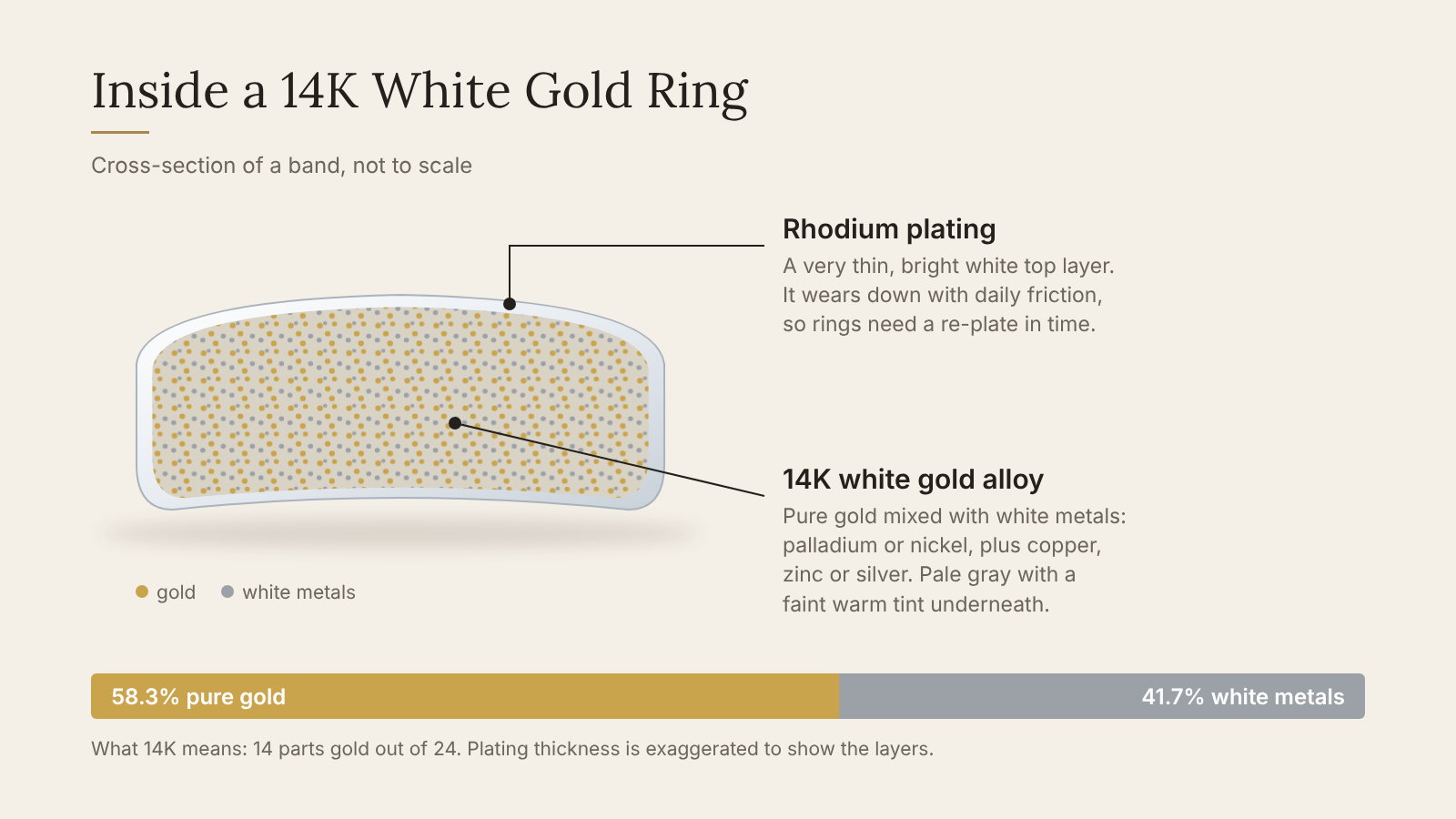
US rule worth knowing: under the FTC Jewelry Guides on rhodium, it's deceptive for a seller to "fail to disclose a surface-layer application of rhodium" on precious metal jewelry.
In plain English, if a white gold ring is plated, the seller should tell you. So it's always fair to ask two questions: is this rhodium plated, and how often will it need redoing?
Is White Gold Real Gold? (Yes, and Here's How to Check)
Yes. White gold is karat gold all the way through, not a base metal with a thin gold coating. A 14K white gold ring holds the same 58.3% gold as a 14K yellow gold ring; only the other 41.7% is different.
Where people get tripped up is fashion jewelry. Pieces sold as "white gold tone" or "silver-tone" are usually brass or another base metal with a thin bright finish, and their value reflects that.
How to check a piece you already own:
- Find the karat stamp. Look inside the band or near the clasp for 10K, 14K or 18K, or the numbers 417, 585 or 750.
- Find the maker's mark. The FTC advice on buying gold jewelry suggests buying karat-marked gold only when it also carries the maker's trademark.
- Watch for plating codes. GP, GF, HGE or RGP after the karat mark means a gold coating over another metal, not solid gold.
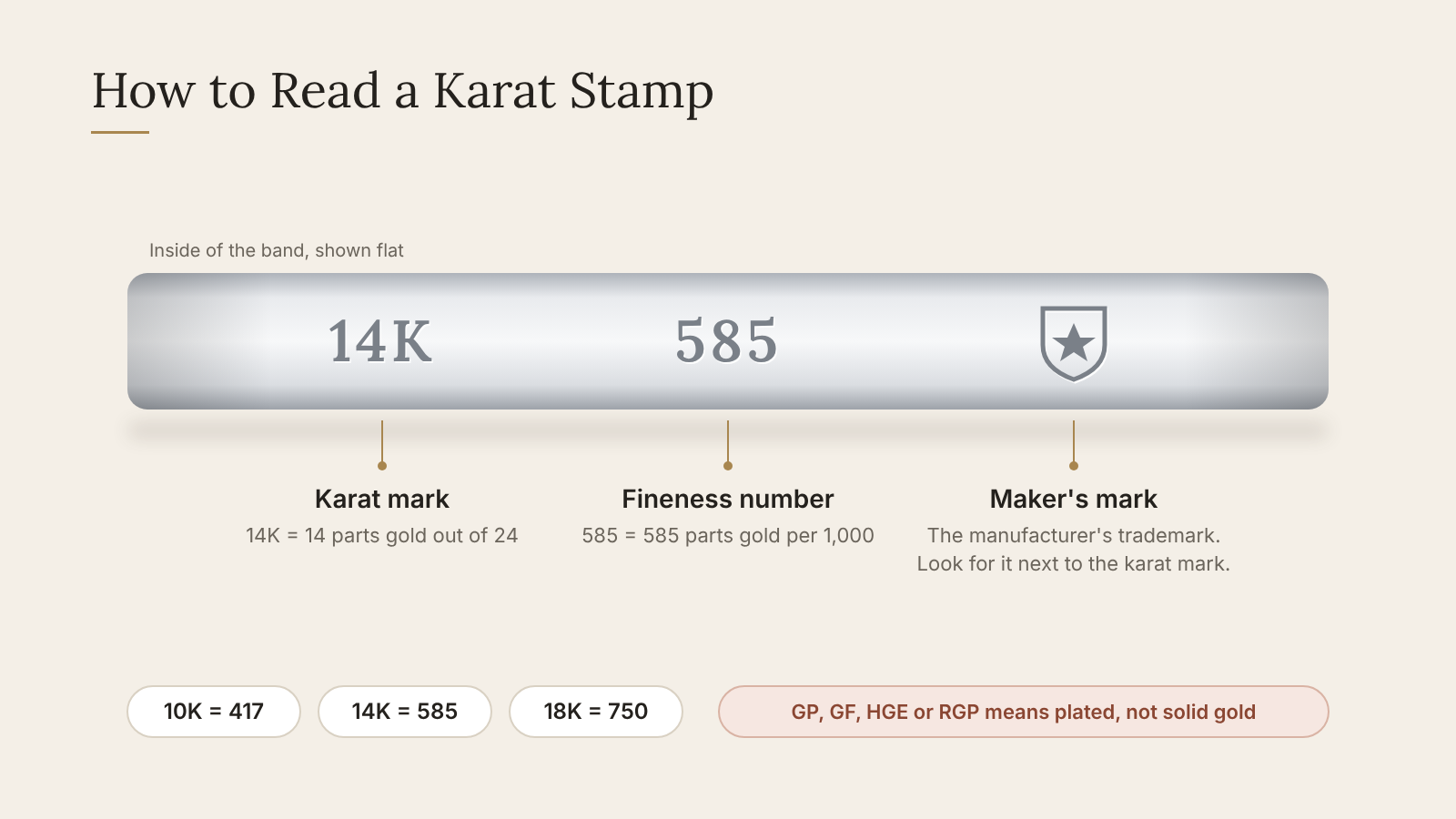
Stamps can wear away or be faked, though. If you've inherited a piece or received a gift you're unsure about, our on-site gemologist can test it as part of our repairs and appraisals.
White Gold Karats: 10K vs. 14K vs. 18K
A karat is one part gold out of 24. The higher the karat, the more gold in the metal, and the softer and warmer it is underneath the plating.
| Karat | Gold content | Stamp | Unplated color | Durability | Best for |
|---|---|---|---|---|---|
| 10K white gold | 41.7% | 417 | Palest gray | Hardest of the three | Budget pieces and hard everyday wear |
| 14K white gold | 58.3% | 585 | Light gray, faint warm tint | Hard; holds prongs and settings well | Engagement rings and wedding bands |
| 18K white gold | 75% | 750 | Warmest, slightly yellow | Softer; shows wear sooner | Fine jewelry and a higher gold content |
There's a US marking rule here too. Under 16 CFR 23.3, an alloy can only be called "gold" when the correct karat mark sits right in front of the word, as in "14K gold." Most US jewelers work in 10K, 14K and 18K.
So which karat do we use? Our 14K white gold engagement rings are made in 14K on purpose. It's strong enough for daily wear and secure prongs, and more than half the metal is pure gold. Some of our fine jewelry comes in 18K white gold for a richer gold content.
From our bench: torn between 14K and 18K for a ring you'll wear every day? Choose 14K. Once plated, both look equally white, and 14K holds up better.
White Gold Meaning: What the Term Really Says
In the dictionary sense, Merriam-Webster describes white gold as a light-colored gold alloy, usually made with nickel or palladium, that looks like platinum. That's exactly what jewelers mean by it too.
The phrase is older than the alloy, though. Merriam-Webster dates its first known use to the 1500s, long before modern white gold rings existed, and it has picked up a few meanings since:
- In jewelry: a gold alloy that looks white, usually finished with rhodium.
- In history and trade: a nickname for prized white goods, such as porcelain, cotton and salt.
- On a ring finger: for many couples, a clean, modern look that lets the diamond lead.
Beyond that, a white gold ring means whatever you bring to it. We just make sure the metal holds up while it does.
Why Does White Gold Turn Yellow? (The Truth About Rhodium)
This surprises a lot of our customers: the gold isn't changing at all. The rhodium plating is wearing thin, and the warm tone of the alloy underneath starts to show.
Rings wear fastest. The palm side rubs against steering wheels, keyboards, door handles and other rings all day, while earrings and pendants barely touch anything and keep their plating much longer.
| Piece | Typical re-plating | Why |
|---|---|---|
| Engagement ring or band worn daily | Every 1 to 3 years | Constant friction on the palm side |
| Ring worn now and then | Less often | Less contact, slower wear |
| Earrings and pendants | Rarely | Very little rubbing |
How do you know it's time? Look for these signs:
- A warm, slightly yellow cast on the palm side of the band
- A patchy finish, with some areas brighter than others
- Your ring looks dull next to a freshly plated wedding band
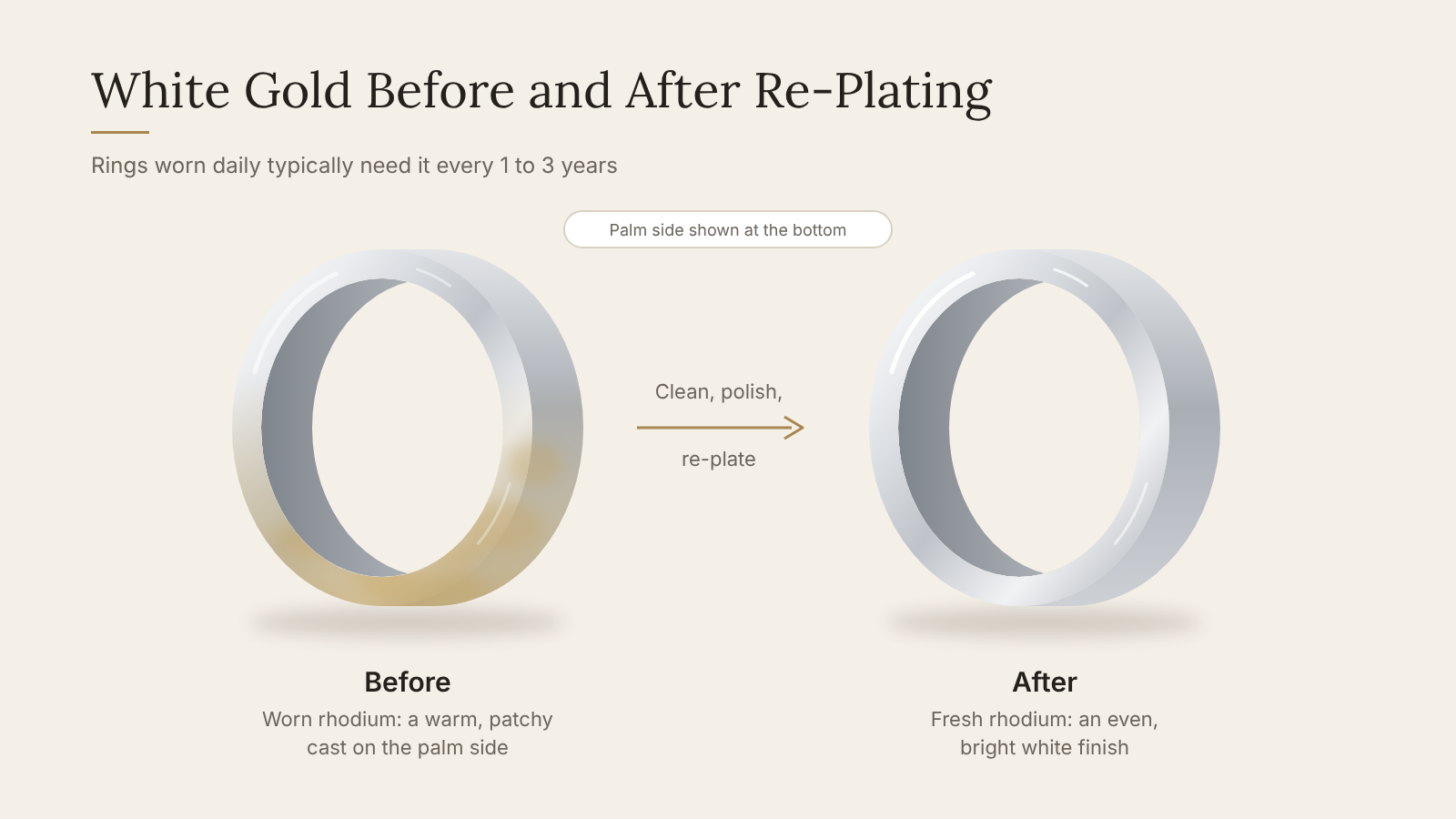
Re-plating is routine bench work. The piece is cleaned, polished to remove light scratches, then electroplated with fresh rhodium, and it comes back looking new.
Bring yours in and we'll take a look. Ask us how The CALVIN'S Promise covers upkeep on engagement rings.
Is White Gold Safe If You Have a Nickel Allergy?
It depends on the alloy. Nickel is one of the most common causes of allergic contact dermatitis, and Mayo Clinic on nickel allergy names jewelry as a frequent trigger.
Rhodium plating acts as a barrier between your skin and the alloy. The problem? As it wears thin, nickel-sensitive skin can react, usually with an itchy red rash right where the ring sits.
If your skin is sensitive, here's what we suggest:
- Ask what's in the alloy. Nickel and palladium white gold look identical once plated.
- Choose nickel-free white gold. Mayo Clinic lists it among the safer jewelry options.
- Keep the plating fresh if you already own nickel white gold.
- Consider platinum if you'd rather skip the question entirely. Our platinum engagement rings are naturally white and need no plating.
If a rash shows up, take the ring off and see a dermatologist. We're jewelers, not doctors, but we're happy to help you find a metal that works for your skin.
White Gold vs. Platinum, Silver and Yellow Gold: Side by Side
White gold sits in the middle of the pack. It's more affordable than platinum, far tougher than silver, and holds the same gold as yellow gold of the same karat.
Here's how the four compare at a glance.
| White gold (14K) | Platinum | Sterling silver | Yellow gold (14K) | |
|---|---|---|---|---|
| Composition | 58.3% gold plus white metals | Mostly platinum, often 95% | 92.5% silver plus copper | 58.3% gold plus silver and copper |
| Natural color | Pale gray, plated bright white | Naturally white-gray | Bright white, darkens with tarnish | Warm yellow |
| Durability | Hard; holds settings well | Dense; scratches but loses little metal | Soft; scratches and bends easily | Similar to white gold |
| Upkeep | Re-plate rings every 1 to 3 years | Polish to restore shine | Regular polishing for tarnish | Occasional polish |
| Relative cost | Moderate | Highest | Lowest | Moderate |
| Nickel-free | Only palladium alloys | Typically | Typically | Typically |
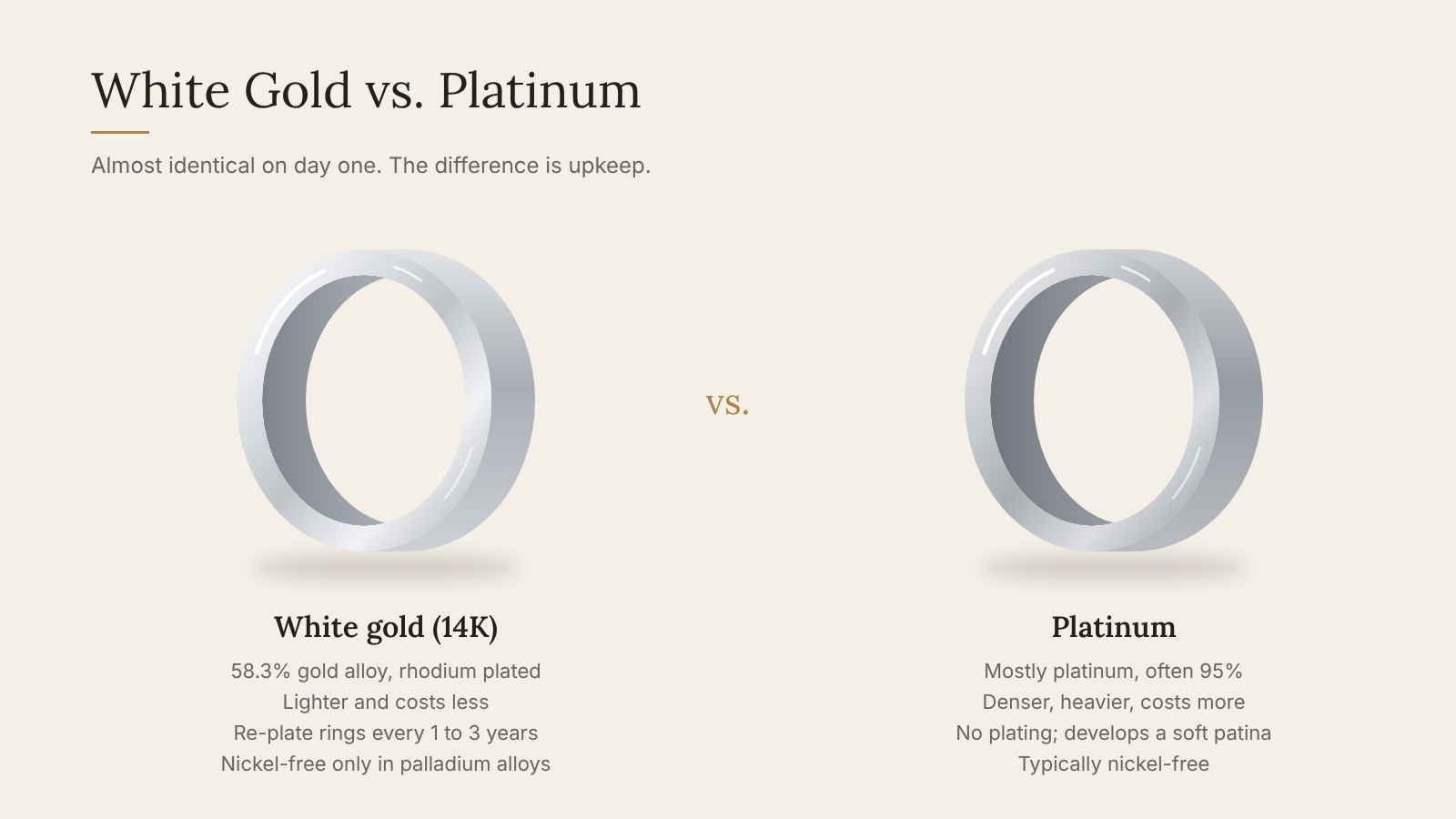
White Gold vs. Platinum
On day one, they look almost identical. The differences show up over time and on the price tag.
Platinum is denser and heavier, costs more, and never needs plating; it slowly develops a soft gray patina instead. White gold costs less and looks brighter after plating, but it needs a re-plate every few years.
From our bench: hold one of our platinum engagement rings next to a white gold ring of the same design. You'll feel the weight difference right away.
White Gold vs. Sterling Silver
Silver is the budget option, and it shows its age faster. Sterling is softer, scratches and bends more easily, and tarnishes as it reacts with air and moisture.
White gold is harder, doesn't tarnish, and holds real gold value. GIA's white gold vs. silver comparison walks through the same trade-offs if you'd like a second opinion.
Quick rule: silver for fashion pieces you'll swap often, white gold for anything you'll wear every day for years.
White Gold vs. Yellow Gold
At the same karat, white and yellow gold contain the same amount of gold and usually cost about the same. The real difference is color and upkeep.
Yellow gold gets its warmth from the gold itself and its silver and copper partners, so there's no plating to wear off. Pick yellow gold if you:
- Love a warm, classic tone
- Would rather skip re-plating
- Want a low-maintenance everyday ring
If that sounds like you, browse our yellow gold engagement rings.
Pros and Cons of White Gold: The Honest Version
We'd rather you buy white gold knowing exactly what it needs. Here's the full picture, good and bad.
| Pros | Cons |
|---|---|
| The platinum look for less money | Daily-wear rings need re-plating every 1 to 3 years |
| Makes near-colorless diamonds look whiter | May contain nickel |
| Real gold with lasting value | Warm base color shows as plating wears |
| Pairs with any stone or style | A bit more upkeep than yellow gold or platinum |
That diamond point matters more than most people expect. GIA on setting metals and diamond color notes that white metal settings make colorless and near-colorless diamonds look whiter.
Want to match the metal to the stone? Our diamond education pages explain color grades, and our guide on how to choose a diamond ring setting covers the rest.
How to Care for White Gold Jewelry (5 Simple Habits)
Good habits stretch the time between re-plates. None of these takes more than a minute.
- Clean it gently at home. Use warm water, a drop of mild dish soap and a soft toothbrush, then dry with a soft, lint-free cloth.
- Take it off for pools and hot tubs. Chlorine is hard on gold alloys and speeds up plating wear.
- Skip harsh chemicals, lotion and the gym. Cleaners, product buildup and barbells all wear the finish faster.
- Store pieces separately. Diamonds are harder than rhodium and will scratch it, so give each piece its own pouch or slot.
- Bring rings in every three months for a professional cleaning and a prong check.
That last habit is the one people skip, and it's the one that saves stones. Our full jewelry care guide covers the rest, including what to avoid for specific gemstones.
Is White Gold Right for You? Here's the Bottom Line
What's the bottom line here? White gold is real gold with a bright white finish that asks for a little upkeep. If that trade sounds fair, it's a great choice.
- Choose white gold if you want a bright white look and real gold value, and you don't mind a re-plate every few years.
- Choose platinum if you want zero plating, or you have a nickel allergy.
The easiest way to decide is to see both on your hand. Book an appointment at our Far West Blvd showroom, and we'll set white gold and platinum side by side in real light.
Already sold on the look? Browse our white gold wedding bands, or design something one of a kind with our custom engagement rings team in any metal. Bring your questions with you. We love talking metal.
White Gold FAQs
Quick answers to the questions we hear most at the counter.
Does White Gold Tarnish?
No. Gold alloys don't tarnish the way sterling silver does.
What you may notice is the rhodium wearing thin, which warms the color slightly. That's wear, not tarnish, and a re-plate restores it.
Is White Gold Worth More Than Yellow Gold?
Not really. At the same karat, both hold the same amount of gold, so their metal value is about equal.
Retail prices can differ slightly because of the alloy metals and rhodium plating.
Can You Shower or Swim With White Gold?
Showering is fine, though soap film dulls the shine over time.
Take it off for pools and hot tubs. Chlorine is hard on gold alloys and speeds up plating wear.
Can White Gold Rings Be Resized?
Most can, and the ring is re-plated afterward so the seam disappears.
Check your size with our ring sizer, and see can eternity rings be resized? for the exceptions.
How Can You Tell If White Gold Is Real?
Look for a karat stamp (10K, 14K, 18K, or 417, 585, 750) next to a maker's mark.
For certainty, have a jeweler test it. Our gemologist can check it during an appraisal.