


Engagement Ring vs Wedding Ring: What's the Difference?
Key Takeaways
- Engagement ring: given at the proposal, built around a center stone, traditionally worn by one partner.
- Wedding ring (wedding band): exchanged during the ceremony, lower and simpler, usually worn by both partners.
- Order on the finger: tradition puts the band on first, closest to the heart, with the engagement ring on top.
- Cost: the engagement ring is usually the bigger purchase. The average was $5,200 in The Knot's 2024 study.
- Fit: raised, halo and hidden halo settings often need a curved band to sit flush, so try bands on with your engagement ring.
- Rules: you don't need both rings, and they don't have to match.
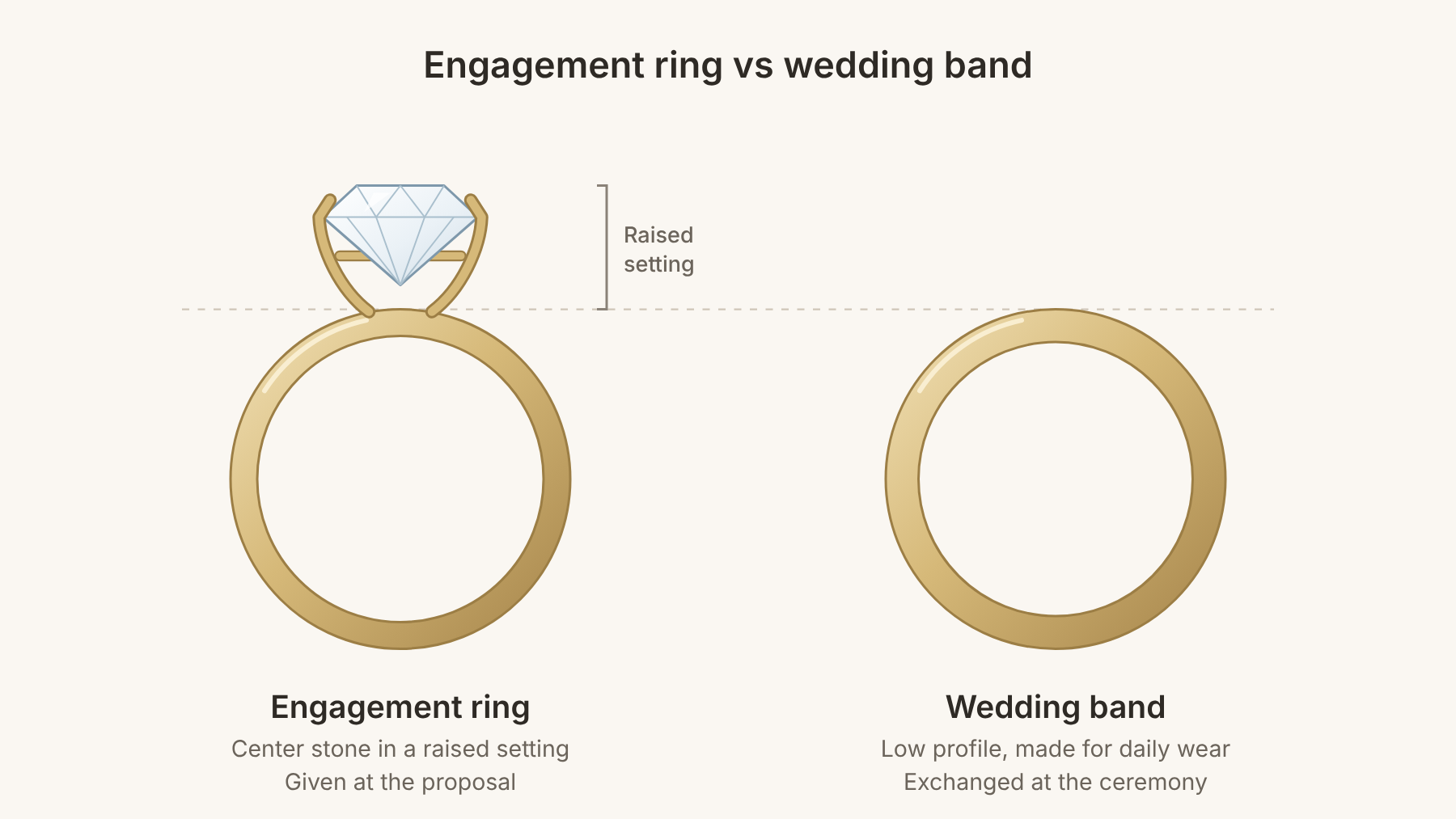
An engagement ring is given at the proposal. It usually holds a center stone. A wedding ring, or wedding band, is exchanged at the ceremony and is usually simpler.
Most people wear both on the left ring finger, band first. That's engagement ring vs wedding ring in a nutshell.
The tricky part? Fit. A band that looks perfect in the case can leave a gap under a raised setting, which is why we fit bands against the engagement ring in person at CALVIN'S, a family-owned Austin jeweler since 1997.
What's the Difference Between an Engagement Ring and a Wedding Ring?
One ring marks the promise. The other marks the marriage.
They also differ in timing, design and who wears them. Here's each one in plain terms.
What Is an Engagement Ring?
An engagement ring is the promise to marry. It's given at the proposal and, by US tradition, worn by one partner from that day on.
Most are built around a center stone: a natural diamond, a lab-grown diamond or a colored gemstone. The setting around that stone shapes the whole look:
- Solitaire: one stone, with nothing competing for attention.
- Halo: a ring of small diamonds framing the center stone so it looks bigger.
- Pavé: tiny diamonds set along the band for sparkle on every side.
Browse our engagement rings to see how each setting changes the ring's height and profile. That height matters more than most people think, and we'll get to why below.
What Is a Wedding Ring?
A wedding ring is exchanged during the ceremony, usually as part of the vows. Unlike the engagement ring, both partners typically wear one.
It's built for everyday life. Most are plain metal or set with a row of small diamonds, and they sit low so they don't snag. Our wedding bands range from simple polished styles to full diamond rows.
Good to know: a full eternity band has diamonds all the way around, while a half eternity band stops at the sides. Either one can serve as a wedding band or as a later anniversary gift.
Wedding Ring vs Wedding Band: Is There a Difference?
No. "Wedding ring" and "wedding band" mean the same ring, so engagement ring vs wedding band is really the same question as engagement ring vs wedding ring.
What is different is a band you add later. Eternity bands and anniversary bands are separate rings, often given for a milestone and stacked with the other two.
Engagement Ring vs Wedding Ring at a Glance
Here's the whole comparison in one place. Use it to check the basics before you shop.
| Engagement ring | Wedding ring (wedding band) | |
|---|---|---|
| Purpose | Marks the proposal and the promise to marry | Marks the marriage itself |
| When it's given | At the proposal | During the ceremony, often with the vows |
| Who wears it | Traditionally one partner | Both partners |
| Typical design | A center stone (natural diamond, lab-grown diamond or gemstone) in a solitaire, halo or pavé setting | Plain metal, or a row of small diamonds |
| Profile | Raised, so the stone catches light | Low, for everyday comfort |
| Cost | Usually the larger purchase; $5,200 average (The Knot 2024) | Usually less; full eternity bands can approach engagement-ring prices |
| Place on the finger | On top of the band | First, closest to the hand |
| Resizing | Usually possible, depending on the setting | Plain bands resize easily; full eternity and tantalum bands generally can't |
| Upkeep | Regular prong checks and cleaning | Mostly polishing |
Notice the last three rows. They matter long after the wedding, and they're the ones most guides skip, so we cover each of them below.
How Engagement Rings and Wedding Bands Differ in Design
Design is where the two rings split the most. One is built to show off a stone. The other is built to survive a Tuesday.
And here's the part nobody tells you: the engagement ring's design decides which wedding band will fit next to it.
Center Stone vs Everyday Band
The engagement ring is built around one stone. Prongs or a bezel lift that stone above the finger so light can enter from every side.
The band does the opposite. It sits low, has no tall prongs and takes the daily knocks: steering wheels, gym bars, dish soap.
Why Your Setting Height Decides Your Band
This is the part most couples learn at the fitting. Whether a straight band sits flush depends on how high, and how wide, the engagement ring's setting is.
- Low-set solitaires: a straight band usually sits flush, so you don't need a curve.
- Raised, halo and hidden halo settings: the basket or halo often leaves a visible gap under the ring.
- Some ovals and pears: a long stone can reach past the setting and bump the band.
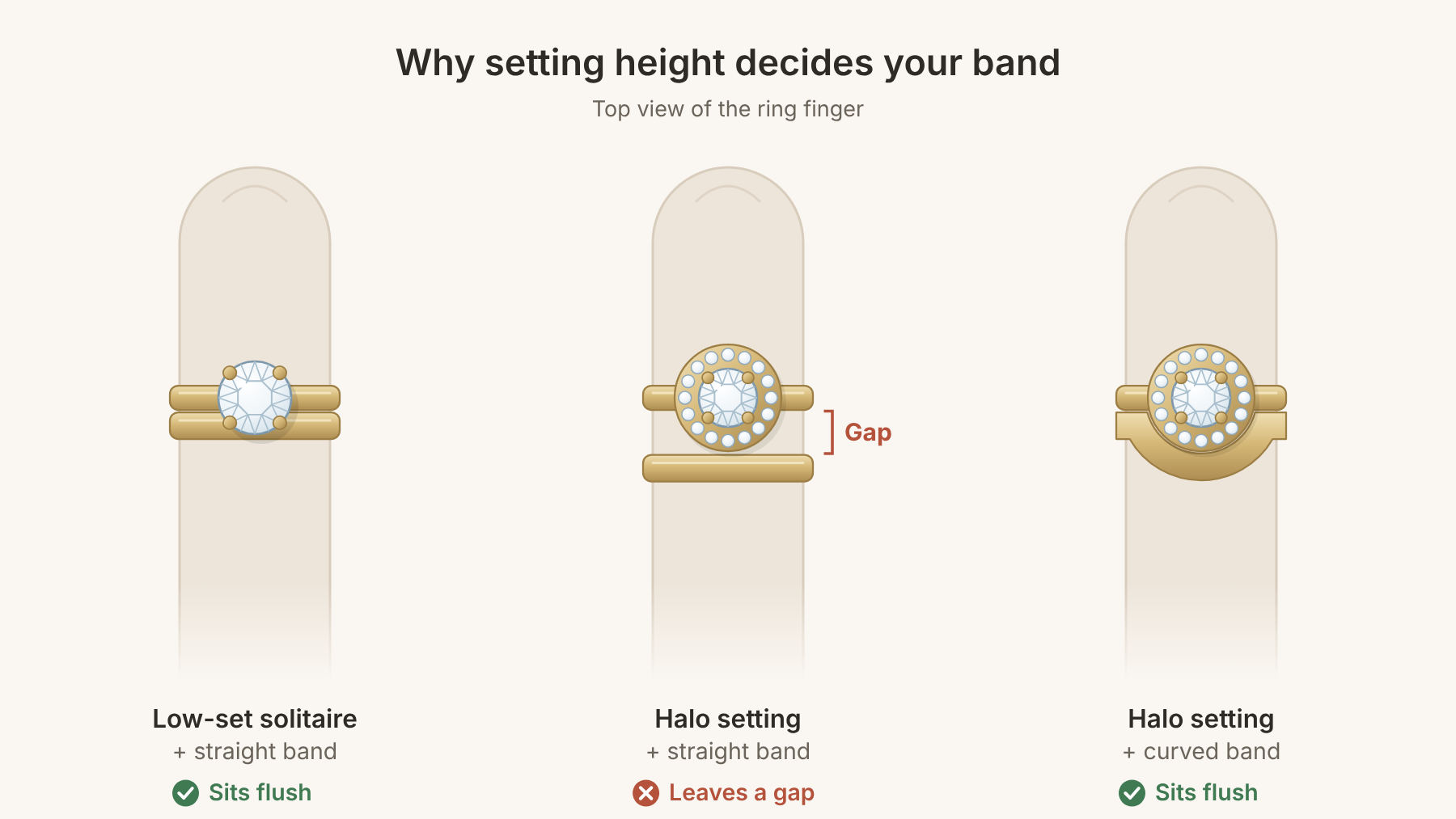
A curved band, also called a contour band, dips to wrap around the setting and close that gap. Our curved wedding bands each curve or notch a little differently, and our guide on how to choose a diamond ring setting explains how setting height gets decided in the first place.
That's why we fit bands in person. Our GIA-certified team slides each candidate band against your engagement ring, so you see the gap (or the lack of one) before anything is made.
Engagement Rings vs Wedding Rings: Which Costs More?
The engagement ring usually costs more, and the center stone is the reason. The average engagement ring cost $5,200 in The Knot's 2024 Jewelry & Engagement Study, and nearly two-thirds of couples (64%) spent less than $6,000.
Lab-grown diamonds are changing that math fast. In The Knot's 2026 Real Weddings Study of 10,474 US couples, 61% of engagement rings had lab-grown diamonds as the center stone, up 239% since 2020. Its lab-grown findings put the average at 1.9 carats for $4,600.
Here's why wedding bands usually cost less:
- Less stone weight: most bands carry small diamonds or none, so the metal is most of the price.
- Simpler build: there's no tall setting to engineer around a center stone.
- The exception: diamond wedding bands and full eternity bands can climb toward engagement-ring prices.
Weighing your stone options? Our lab diamonds vs mined diamonds guide breaks down the trade-offs.
Traditionally, the person proposing buys the engagement ring, and couples often choose their bands together. Either way, financing can spread the cost of both.
How to Wear an Engagement Ring and Wedding Ring Together
In the US, most people wear both rings on the fourth finger of the left hand. The custom traces back to an ancient belief in the vena amoris, or "vein of love," said to run from that finger straight to the heart.
It isn't real anatomy. But the tradition stuck, and it still shapes how the two rings go on.
Which Ring Goes On First?
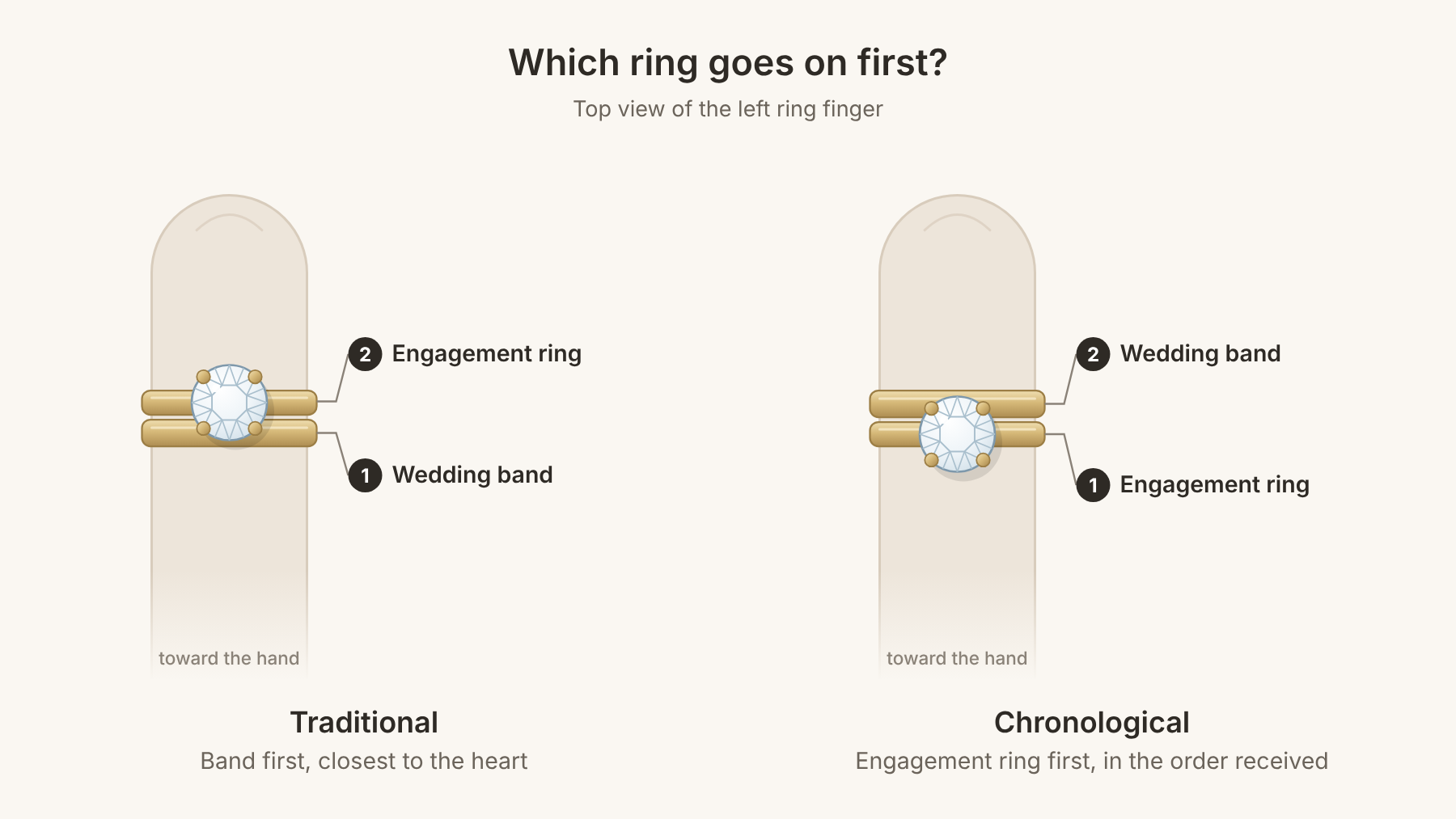
Tradition puts the wedding band on first, closest to the heart, with the engagement ring on top. GIA describes this as the classic arrangement.
Some people flip it and wear the rings in the order they received them, engagement ring first. Others simply find the engagement ring more comfortable at the base of the finger, and that's fine too.
What to Do on the Wedding Day
Want the band closest to your heart from day one? Plan a quick swap before you walk down the aisle.
- Move your engagement ring to your right hand before the ceremony.
- Receive the wedding band on your left ring finger during the vows.
- After the ceremony, slide the engagement ring back on, on top of the band.
No awkward ring shuffle at the altar, and the order is set from the first photo.
Other Ways to Wear Them
Tradition is a starting point, not a rule. Here are the setups we see most often:
- Separate hands: engagement ring on the right, band on the left.
- Band only, some days: wear the band for work, travel or the gym, and save the engagement ring for evenings.
- Soldered together: a jeweler joins the two rings so they never twist or rub against each other.
- Add to the stack: pair them with a stacking band later for an anniversary or a new baby.
Customs also vary by country: in places such as Germany, Russia, Poland, Greece and India, wedding rings are often worn on the right hand. One note on soldering: it turns the pair into a single ring, so any future sizing applies to both.
Do You Need Both an Engagement Ring and a Wedding Ring?
No rule says you need both. The wedding ring vs engagement ring question really comes down to budget, lifestyle and what feels meaningful to the two of you.
Here are the four setups we see most:
- Both rings, stacked or worn on separate hands
- The engagement ring alone, with no band
- A wedding band alone, often a diamond band
- One diamond band doing both jobs, given at the proposal and worn as the wedding ring
Still, most proposals start with a ring. Nearly 9 in 10 proposers propose with a ring in hand, according to The Knot's 2026 Real Weddings Study.
Do Men Wear Engagement Rings?
Some do, and more men are choosing to. Most, though, wear only a wedding band, often in a wider width or an alternative metal.
Our men's wedding bands are made to order in classic gold, two-tone and tantalum, and nearly all are comfort-fit. One heads-up: tantalum can't be resized later, so get measured before you order.
Do Your Engagement Ring and Wedding Band Have to Match?
They don't have to. But matching the metal is the one rule we'd push for: it keeps the color consistent, and it keeps one ring from wearing down the other faster.
Start by picking your metal family:
- White gold wedding bands for a bright, cool look
- Yellow gold wedding bands for warmth and a classic feel
- Platinum wedding bands for a naturally white metal with real heft
A bridal set is an engagement ring and band designed as a pair. If you already have the engagement ring, a custom wedding band can be shaped to it instead, and our Iconic Collection shows CALVIN'S own engagement designs.
Partners' bands don't need to match each other either. Plenty of couples choose different metals, widths and finishes, then tie them together with a shared engraving.
Bench tip: bring the engagement ring to your band appointment. Matching a metal from a photo is guesswork. Matching it on your finger isn't.
When to Buy Your Engagement Ring and Wedding Band
Engagement ring first, band second. That order gives you time for both without a deadline crunch.
- Engagement ring: before the proposal. The Knot found 60% of proposers buy about two months ahead. Allow extra time for custom engagement rings, which are designed and made from scratch.
- Wedding band: after the engagement. Shop with the engagement ring on your hand so the band can be fitted to it. Our bands are made to order, so give yourself a cushion of a few months before the wedding.
- Sizing: in person, before you order. Full eternity bands generally can't be resized, and tantalum bands can't be resized later either. Get measured in the studio, or start with our ring sizer.
Plain metal bands are the forgiving ones. If your size changes down the road, a jeweler can usually size them up or down without fuss.
A Short History of Engagement and Wedding Rings
Rings have stood for forever for a very long time. Ancient Egyptians saw the circle, with no beginning and no end, as a symbol of eternity, and the Romans later used iron and copper rings in marriage before moving to gold, according to GIA.
The split into two rings came later. GIA notes that once the church formalized marriage in the 12th century, a personal betrothal ring and a church-sanctioned wedding ring may have emerged as separate pieces.
- 1477: Archduke Maximilian of Austria gives Mary of Burgundy the first recorded diamond engagement ring (American Gem Society).
- 1930s: with diamond sales slumping, De Beers launches a campaign built around glamorous film stars.
- 1947: De Beers introduces the slogan "A Diamond Is Forever."
- 1940s and 1950s: men's wedding bands catch on after soldiers in World War II wear them as reminders of home.
The surprising part? The campaign worked. GIA reports that the share of US brides receiving a diamond engagement ring climbed from 10% in 1939 to 80% in 1990.
Find Your Wedding Band at CALVIN'S in Austin
Engagement ring vs wedding ring is the easy question. Getting the two to sit together perfectly is where we come in.
Bring your engagement ring to our Austin studio. Three generations of CALVIN'S jewelers will try bands against it, show you straight and curved options side by side, and make your band to order in your size.
- Fitted on your hand: no guessing from photos.
- Made to order: sized, finished and fitted in our own shop.
- Cared for after: The CALVIN'S Promise covers complimentary lifetime cleaning, polishing and inspection.
Ready to see them together? Book a band fitting today, or start browsing our wedding bands and bring your favorites to the appointment.
Engagement Ring vs Wedding Ring FAQs
Is an engagement ring the same as a wedding ring?
No. The difference between an engagement ring and a wedding ring is timing and purpose: one is given at the proposal, the other at the ceremony.
The engagement ring usually has a center stone. The wedding ring is usually simpler.
Which ring goes on first, the engagement ring or the wedding band?
Traditionally, the wedding band goes on first, closest to the heart.
The engagement ring then sits on top. Some people wear them in the order they received them instead, and that works too.
Can your engagement ring also be your wedding ring?
Yes. Some people skip the band and let the engagement ring do both jobs.
Others propose with a diamond band and wear it as the wedding ring. You can always add a band later.
Do you wear your engagement ring on your wedding day?
Usually, yes, but on the right hand during the ceremony.
That leaves your left ring finger free for the band. Afterward, slide the engagement ring back on top.
Why are engagement rings more expensive than wedding rings?
The center stone. Most of an engagement ring's cost sits in the diamond or gemstone.
Wedding bands carry little or no stone weight, though diamond and full eternity bands can cost more.
Can a wedding band be resized?
Plain metal bands usually can be sized up or down.
Full eternity bands generally can't, because diamonds circle the whole ring, and tantalum bands can't be resized later. Get sized carefully before you order.